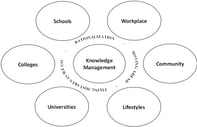

Concerns about the pace of contemporary learning environments are increasingly common across higher education and professional training contexts. Accelerated program timelines, rapid technological change and expanding competency expectations often lead to calls for slower instruction and additional scaffolding. While these responses are well intentioned, they frequently misdiagnose the source of learner difficulty.
Learning challenges are often attributed to speed when the underlying issue is structural misalignment. Modern learning environments require learners to operate across multiple dimensions simultaneously. These dimensions include conceptual understanding, spatial orientation, temporal management, technological interaction and ethical judgment. Difficulty arises not because learning is occurring too quickly but because these dimensions do not align coherently.
Traditional instructional models assume that learning unfolds linearly. Content is presented, processed and assessed in sequence. Digital learning environments, however, rarely function in this way. Learners must interpret interfaces, navigate spaces, manage deadlines and interact with systems while simultaneously engaging with academic content. When these demands conflict, cognitive load increases and comprehension suffers.
In response, institutions often slow instruction by reducing content density or extending timelines. While these measures may provide temporary relief, they do not address the fundamental issue of dimensional coordination. Learners remain required to reconcile competing demands, only over a longer period. As a result, confusion persists and engagement declines.
Dimensional learning offers an alternative framework for understanding these challenges. Rather than focusing on pace, this perspective emphasizes alignment across the dimensions in which learning occurs. When conceptual, spatial, temporal and technological elements support one another, learners can engage efficiently with complex material without overload.
Spatial orientation is a critical dimension in digital learning. Learners must understand where they are within an environment, how elements relate and what actions are expected. Poor spatial design forces learners to devote cognitive resources to navigation rather than understanding. Clear spatial structure, by contrast, allows learners to focus attention on meaning rather than mechanics.
Temporal design also plays a significant role. Learning environments that communicate timing implicitly through structure reduce uncertainty and support self-regulation. When learners understand the rhythm of interaction, feedback and progression, they are better able to manage effort and attention. Confusion about timing often manifests as perceived speed, even when content volume is modest.
Technological interaction introduces additional complexity. Digital systems mediate learning through interfaces that may or may not align with instructional intent. When technology introduces unpredictability or inconsistency, learners experience friction that disrupts cognitive processing. Aligning technological behavior with learning goals reduces this friction and supports engagement.
Conceptual understanding remains central to learning but must be supported by these other dimensions. When learners are oriented spatially, temporally and technologically, they are better positioned to engage deeply with ideas. Explanation becomes more effective because it is grounded in a coherent experience.
Ethical judgment represents an increasingly important dimension as learning environments incorporate automation and artificial intelligence. Learners must interpret system outputs, evaluate implications and make decisions within constrained contexts. This dimension cannot be isolated from others; ethical reasoning occurs within environments shaped by technology and time pressures.
When dimensional alignment is achieved, learning can proceed efficiently without sacrificing depth. Learners move through material with confidence because the environment supports understanding. In such cases, speed is not an obstacle but a reflection of coherence. Learning feels manageable because demands are integrated rather than competing.
Conversely, when dimensions are misaligned, even slow-paced instruction can feel overwhelming. Learners may struggle to identify priorities, interpret feedback or understand expectations. The resulting frustration is often attributed to workload or difficulty, masking the structural causes.
Designing for dimensional alignment requires a shift in instructional focus. Rather than asking how much content can be delivered within a given timeframe, designers must consider how learners experience the environment as a whole. Questions of orientation, interaction, timing and feedback become as important as content selection.
Assessment practices also benefit from this perspective. Evaluating learning within coherent environments provides insight into learners’ ability to operate across dimensions. Performance-based assessment, reflection and scenario-driven evaluation capture competencies that traditional testing may overlook.
From an institutional standpoint, addressing dimensional learning requires collaboration across roles. Faculty, instructional designers and technologists must work together to ensure that environments support coherence. Governance structures should recognize that learning quality depends on design alignment as much as instructional content.
Reframing concerns about a sixth dimension of pace—living rather than experiencing the learning—raises questions of dimensional alignment and allows institutions to respond more effectively to learner needs. Rather than slowing learning indiscriminately, educators can design environments that support clarity and engagement. In doing so, they create conditions in which learning can occur efficiently and meaningfully.
You Might Also Like