

Cheap, capable AI can widen the door to higher education and, at the same time, quietly weaken the judgment a credential is supposed to certify. The difference comes down to one design choice.
Most of the conversation about AI in higher education is a conversation about access: AI tutors that never sleep, AI advisors that scale up to thousands of students and AI writing support for learners who never had any. For continuing, professional and online programs built around nontraditional learners, that promise matters. These are the students with the least slack: working adults, parents, first-generation students and people returning to school years after they left it. Anything that lowers the cost of good support and meets them where they are is worth taking seriously.
However, there is a quieter question underneath access, and it is the one that should hold a program leader’s attention. It is not who gets AI. It is what the AI is doing to the learner’s own capability while it helps. Two programs can deploy the same tool and produce opposite results. One builds the student’s judgment, while the other quietly stands in for it. The difference is not the technology but how the program designed the learner’s relationship to it.
Same Tool, Opposite Effect
Cheap, capable AI can concurrently widen access and stratify the conditions under which judgment actually forms. In well-resourced programs with small sections and strong instruction, AI tends to supplement what a good teacher already does. It gives feedback, suggests directions and frees time for harder conversations. In stretched programs, the ones running on thin margins, large sections and constant pressure to move adult learners to completion quickly, the pull is different. There the temptation is to let AI do the work the instruction used to do. Same tool. One program uses it to build capability. The other, without meaning to, uses it to replace the formation of capability with the appearance of it.
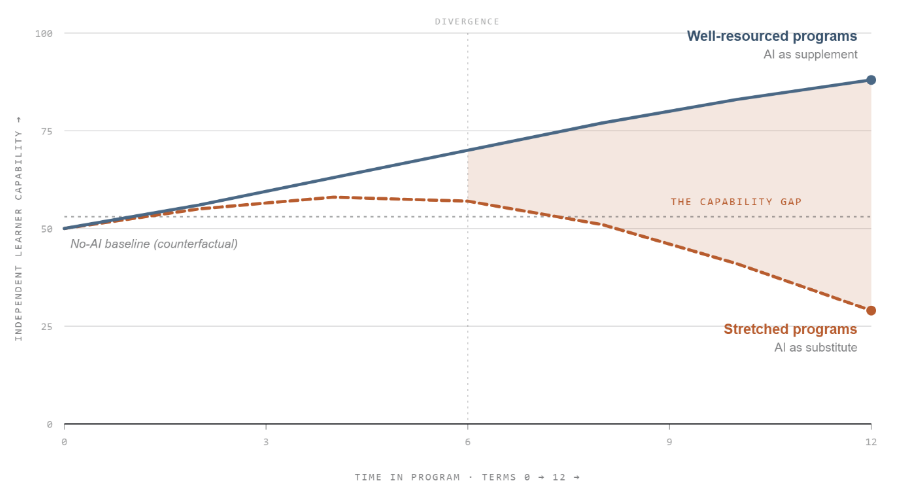
The stratification effect:Two programs deploy the same tool. Where AI supplements strong instruction, independent capability keeps rising; where it substitutes for stretched instruction, capability plateaus and slips even as completion continues, opening a widening capability gap.
That second pattern lands hardest on exactly the learners continuing education exists to serve. Picture an accelerated online program where AI quietly drafts the discussion posts, outlines the case analysis and supplies the answer, all in the name of speed and completion. The learner came back for capability, the kind they can carry into a job, a promotion or a career change. If the system does the reasoning for them, they can finish the program and leave without the thing they came for.
The credential still gets issued, but the labor market does not pay for the credential. It pays for what the credential is supposed to certify. When AI substitutes for formation, the gap between the two widens, and it widens most for the learners who can least afford to have the difference discovered later.
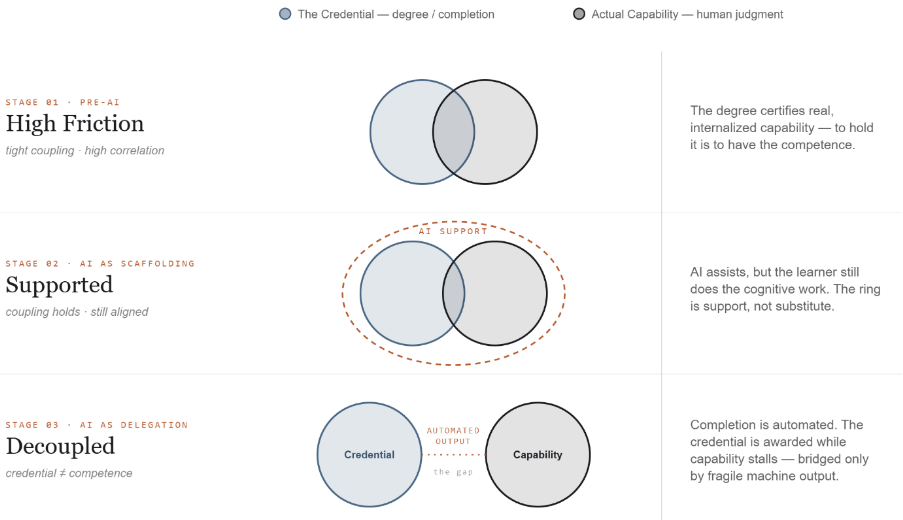
Credential and capability decoupling: When AI scaffolds, the degree and the competence it certifies stay coupled. When the work is delegated to AI, the two come apart. The credential is still issued, bridged to actual capability only by fragile automated output.
This is not a passing technological hurdle. It is a structural shift in how judgment forms when everyday cognitive work is handed to predictive platforms—part of what I have elsewhere called hosted cognition. When an algorithm handles the messy, iterative work of thinking, the learner does not just offload a task. They skip the practice that builds baseline competence in the first place.
There is early, much-debated evidence that the worry is not abstract. A 2025 MIT Media Lab study tracked people writing essays with an AI assistant, with a search engine or with no tools and found the heavy-AI group showed lower neural engagement, weaker recall of their own writing and a thinner sense of ownership over it. It is a small, preliminary study, and its own authors have pushed back on the alarmist headlines it produced, but the mechanism it points to is familiar to anyone who has taught. When a tool removes the effort, it can also remove the learning the effort was producing. The question for a program is not whether that can happen. It is whether the program is designed to prevent it.
A Test Leaders Can Apply
The useful distinction here is older than AI. It comes from scaffolding—the support a teacher gives a learner to do something they cannot yet do alone, withdrawn as the learner grows into the task. Wood, Bruner and Ross first introduced the term in their 1976 study. What makes it operational for AI is a simple test. Scaffolding acts on work the learner has already produced. It questions a draft the student wrote, checks reasoning the student attempted and points to a gap the student can then close. Delegation produces the work in the learner’s place. It writes the draft, runs the analysis and supplies the answer. The first builds the learner’s capability. The second performs it for them. Most AI tools can be used either way, so which way they are used is a design decision, not a property of the tool.
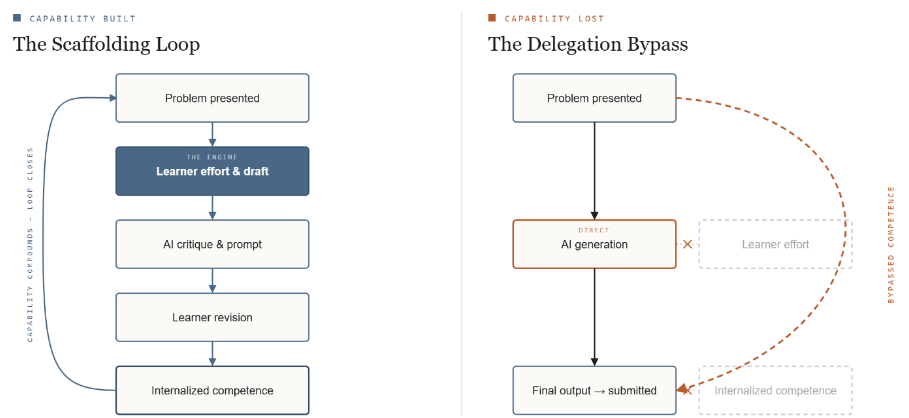
Scaffolding vs. delegation:The same AI tool wired into two architectures. Scaffolding acts on work the learner has already produced and feeds back into their effort (building capability), while delegation produces the work in their place, bypassing the learner’s effort and the competence it would have formed (losing capability).
For program and institutional leaders, that turns a vague debate into concrete choices:
1. Audit AI deployments by the scaffolding-versus-delegation test, not by whether a tool uses AI. For each one, ask whether it acts on the learner’s output or produces output for the learner.
2. Protect a small number of high-effort tasks in every program where the learner works without the tool and tell adult students plainly why those moments exist. Learners pressed for time deserve the reasoning, not just the rule.
3. Be most careful about using AI to cut instructional cost in the programs serving the most vulnerable learners. That is where substitution does the most damage and is the hardest to see on a completion dashboard.
4. State the value proposition plainly, in design and in marketing. The program certifies capability, not attendance, and the experience should be built to produce it.
None of these points constitute an argument against AI in continuing or online education. Used as scaffolding, it can do what its champions promise, including widening access for learners the traditional system left out. The argument is that access to a credential and the formation of capability are not the same thing, and AI makes it newly easy to deliver the first while quietly skipping the second.
The equity question for this decade is not only who gets the tools. It is who still has judgment of their own after the tool is put down. For the learners continuing education was built to serve, that is the difference between a credential that opens a door and one that does not.
You Might Also Like